Features
An Art Adventure: Crossing Frontiers.
One evening in the mid-90s I went to a laid-back dinner party in Notting Hill. I sat next to a cool hip young woman who out of the blue asked me: “What do you think about contemporary art?”
I was flummoxed. I had lots of thoughts about her, but no real opinion about art. She told me she was working at the Serpentine Gallery and invited me to their show, ‘Here and Now’.
I tootled along, mainly to see her again, but I was then drawn to the work on the walls. Deliberately I started by looking at the pictures and not the names. Then I returned to look at the names of the two artists whose work resonated with me.
One was called Howard Hodgkin who was an entirely new name to me. The other was Francis Bacon, whose name I had heard but knew nothing about.
I was immediately struck by Hodgkin’s works, as he was a great colourist, and I loved the way he painted his picture frames. Bacon’s work was powerful and disturbing, but so distinctive and unique.
I didn’t realise it at the time, but it was the beginning of an art journey.
Later that year I went to Kenya for Christmas at the home of the photographer of “Vanishing Africa”, Mirella Ricciardi, and her husband the adventurer Lorenzo. Another guest there was a tall, charming man called Henry Wyndham, soon to become Chairman of Sotheby’s. When I mentioned I was interested in starting to collect art, he recommended several books to read, including “20th Century Painters” by Frances Spalding.
On my return I bought it and leafed through with increasing intensity, sticking Post-It Notes on pages of artists’ work that appealed to me.
A theme soon emerged. I was particularly drawn to the works of a group of artists active in St Ives, Cornwall during the early 20th century: names like Barbara Hepworth, Ben Nicholson, Winnifred Nicholson, Christopher Wood, Alfred Wallis, Peter Lanyon.
It was a very British group of artists, and I especially liked their use of colour and sometimes primitive craft-like compositions and was fascinated by how their personal lives seemed to be intertwined with each other.
At the same time, I had started enthusiastically visiting exhibitions, art galleries and museums as well as visiting dealers to continue my quest to see what I liked so I guess I was starting a collection.
Beginnings
Until then, fine art had not played a major role in my life. When I was growing up, we moved house often, from Sri Lanka where I was born and then to different parts of Ireland.
My first encounter with a real artist was while I was at a monastic school – Tristram Hillier, the English surrealist whose work was displayed there, lived nearby. His daughter Anna-Claire became a close friend. I would later stay at their home where he had set up a makeshift altar in his studio to continue the mass in Latin with one of the freelancing monks, surrealist in itself.
It is no coincidence that my very first adventure in the art world was to buy his painting Godney Moor 1980 which has given me enormous pleasure for many years.
I began my career as a Birds Eye travelling rep, then an account exec on Weetabix, Whitworths Dried Fruit and Ready-Mix concrete. The future looked very boring, so I dropped out to travel, find love and peace eventually ending up in a nudist colony on Formentera, Ibiza reading Karl Marx’s Das Kapital - until money ran out and winter came.
On returning to London, I fell into selling hand-crocheted shaggy coats from Gozo on the Portobello Road, Kensington Market, Chelsea Market and Petticoat Lane.
I was drawn to handicrafts and wanted to see the communities that created them; I was up for anything that was anti-industry or anti-corporate or just anti. The Beatles had just been to India, so like many of my generation, why not me? I eventually drove overland from London via Turkey, Iran and Afghanistan to Jaipur, India, on a craft discovery adventure that changed my life.
What really turned me on was the craft of hand-block printing, the whole three-week process to make a wooden block, where a separate block was required for each colour, each stamp of a block using vegetable dyes on handloomed cotton created magical clothing.
I started importing these bohemian ethnic colourful hand-block-printed garments, the result of hours of craftsmanship in villages in Rajasthan. I love them to this day and fortunately millions of customers agree with me. The business grew over the years; I opened my first shop in Knightsbridge, then lots of shops and they became what is Monsoon and Accessorize today.
In those early days, I would sit with fashion and textile designers sifting portfolio after portfolio to select works on paper which we would convert onto fabric for clothing collections. A critical part of the DNA of Monsoon is the colours and the prints. In retrospect, I realise this work honed an ability to recognise good composition with colour balance. Having developed a good eye for a great print on a dress, I can normally zero in on the best combination of colour and composition in a picture.
Friends and guides
As I began my adventures in the art world, I was very fortunate to meet friends who have advised me well. Henry Wyndham was one, but undoubtedly the most influential was Ivor Braka.
Like so much in this story there was a good deal of fate and good luck involved. At a niece’s wedding I sat next to a friend of Ivor’s and she took my number. By Monday morning, Ivor had already left five messages on my answerphone to discuss my growing interest in contemporary art.
At first, I held on tight to my wallet. Beneath his Iggy Pop demeanour, however, I found in Ivor a serious, passionate, highly intelligent art scholar with a wealth of knowledge and a superb eye.
With Ivor’s help and through his introduction to the serious, compassionate gallerist Thomas Dane and, more recently, Andrew Bonacina, as well as to numerous artists, I started collecting in earnest, focused on both those British artists I had originally been drawn to and more contemporary artists who were fresh on the scene.
I was very fortunate to meet Ivor and Thomas early in my journey and I credit them enormously with guiding me in the right direction.
I was so lucky it was them. I always said I only wanted at least a 9/10 example of an artist, so they proposed very good works by those artists.
The early days of creating my collection were so exciting. Wherever I went, I visited museums, art galleries in Paris, New York, Moscow and St Petersburg, attending biennales in São Paulo, Havana and Mexico. I loved the whole process, especially meeting the artists (painters have always been my thing, not sculpture, video or weird installations) and it was fascinating to understand the interrelationships between them, who inspired or influenced each other. Then there was the excitement of tracking down the works that moved or excited me and the thrill of bidding for them at auction, before the enormous pleasure I have had of hanging them in my home or office, where they have given me years of pleasure, day after day.
The Monsoon Collection
In the late 90s, Monsoon Accessorize moved its HQ to The Battleship building, a brutalist ex-British Rail building, by the canal in Paddington in West London.
With more walls I had the opportunity to build a new collection. It was triggered by the incredible graffiti with which squatter artists had “decorated” the inside of the building before I purchased it. I was keen to introduce my new love of art and collecting to the space but felt that perhaps a collection with a different focus was necessary.
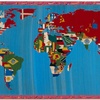
In 2000, after a meeting with the Tate Director Nicholas Serota and gallerist Thomas Dane, I embraced their suggestion of creating a truly international collection of contemporary art, with a focus on artists working in new and developing cultural centres - places such as Latin America, Africa and Asia. This also reflected the scope and scale of Monsoon/Accessorize, which by then had become a global business with outlets in 84 countries and sourced craft pieces from around the world.
The very first piece that entered the Monsoon Art Collection was Kim Sooja's wonderful Bottari Truck, fresh from its exhibition in the Venice Biennale and the exhibition Cities on the Move. The truck was driven to the new headquarters and parked in our foyer. For me the appeal of this piece – a real Korean truck loaded with bundles of brightly coloured fabrics – lay in the way it reminded me of the bundles of hand-block-printed fabrics that would come on three-wheelers from the printing villages around Jaipur, to be tailored into creations by Monsoon’s designers.
All the works in the Monsoon collection have a story behind their purchase. The Collection was funded by me privately not by the trading business; any risks are mine. I just hope that as my colleagues and visitors pass through the lobby the works by Jeff Koons and Andy Warhol, Damien Hirst and Hurvin Anderson, Beatrix Millares and Alighiero Boetti, David Hockney and Bridget Riley provide them with a moment of inspiration or reflection that enriches their daily life.
2026
In early 2026, I visited Tate Britain to see a Lee Miller photo exhibition. Afterwards I strolled through a few rooms of the permanent collections; in just two rooms I saw works of 11 artists I realised I lived with every day at home. I suddenly thought why invest in similar works that can be enjoyed for free in a museum? It also coincided with a feeling I had been having for some time; I had lost interest in buying art, my walls were full, I had stopped going to art auctions, Art Basel, visiting galleries or dealers. Things were static. I was bored.
Then I remembered something the art dealer Leslie Waddington said to me as I started to collect, “if you walk past a picture at home which doesn’t disturb or move you, it’s time to sell it.”
Nothing stands still, and certainly not an art collection, which should always develop and evolve. Time moves on and there is a time to release and let go, so I concluded the only thing to do is to offer much of my collection to others, so it can excite them and enrich their lives in the way it has done for me.
In letting go, I am making space for change. Walls will be bare, ready to start in a new direction which I feel already – I just purchased a wonderful sculpture by Lynda Benglis called Winged Victory. I would like to collect more work by exciting, emerging artists who move me.
END